
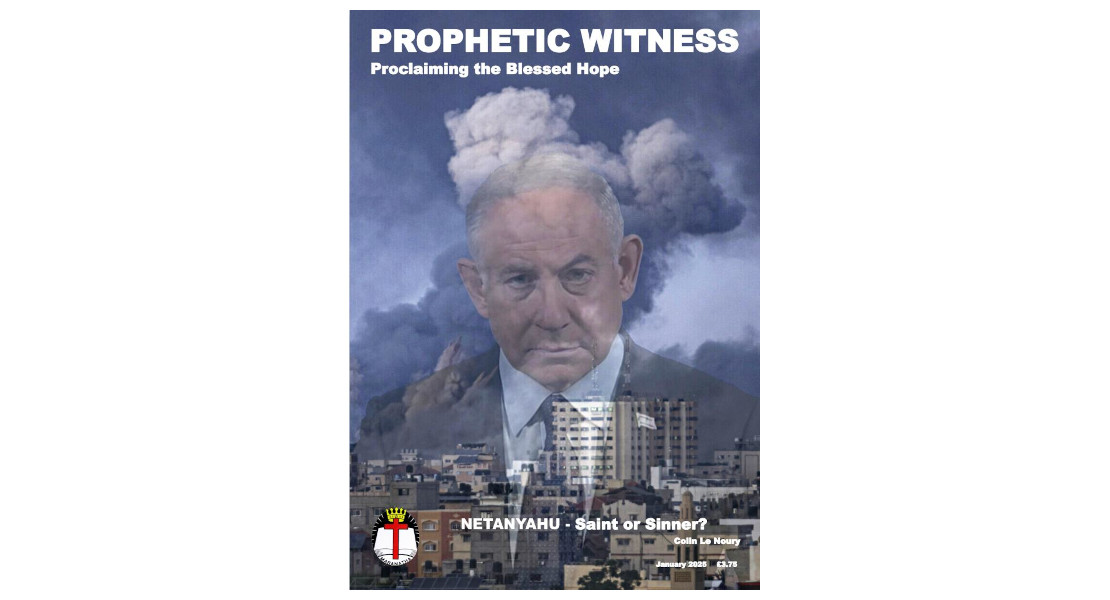
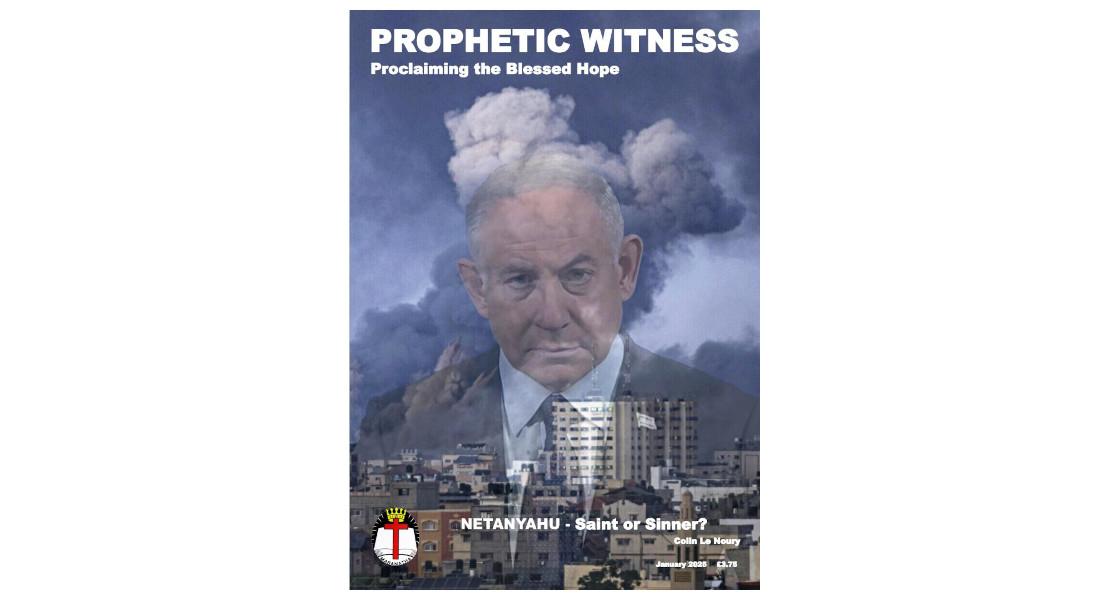
(Note: This month's promoted article is not the magazine frontpage article.)
The Lingering Legacy of A-Millennialism
Donald CB Cameron
Another article on A-Millennialism? Why? Firstly, because A-Millennialism detracts from the expectation of, and preparedness for, our Lord’s return. Secondly, because within Christendom, virtually all Anti-Semitism has arisen from A-Millennialism, even if many A-Millennialists are not Anti-Semitic. In this article I am concentrating on the first problem, with only brief closing remarks on the second.
As Pre-Tribulationists, we have Bible-based confidence in what we believe about the future. From an earthly perspective, the next prophesied event is the Rapture of all living saints, followed by the appearance of the Antichrist, the Tribulation Period, the Battle of Armageddon, Christ’s return in power and glory, the Sheep and Goats judgment, the Millennium, a final brief rebellion, and the end of the world. The Rapture aside, all unfulfilled prophecies of events on earth, fit either into the Tribulation Period or into the Millennium. Most of the ominous ones fit into the Tribulation Period and the happier ones into the Millennium. Post-Tribulationists believe the same as Pre-Tribulationists, apart from when the Rapture takes place. Post-Tribulationists expect to see the Antichrist before Christ!
The contrasts between the different schools of prophecy, primarily concern the sequence in which end-time events are to be fulfilled.
One element of A-Millennialism, is that there is to be no Millennial Kingdom after the Lord’s return. Also, they do not believe in a pre-Tribulation Rapture, which is to separate believers from unbelievers, well before what they see, as Christ’s coming to end the world. Their Options, when dealing with prophecies relating to these things, are to:
1) disbelieve the Bible prophecies;
2) allegorise them; or
3) assume that they are still a long way off; in which case there is no need for them to prepare for a potentially imminent return of the Lord Jesus Christ.
But recently there has been, in some A-Millennial churches, a feeling that, perhaps the Lord’s return is not so far away after all, leading to a desire to know more about what Scripture foretells. However, as this is being done within the framework of a foreshortened A-Millennial programme, many of the Old Testament ‘latter days’ prophecies are seen to be puzzling. It is tempting for them to give up. The truth, is that the A-Millennial programme is wrong, and the prophecies are literal.
Those of us whose end-time programme co-ordinates smoothly with all the individual prophecies, have a responsibility to preach or teach that programme, and to do so in a way which does not alienate others, or cause others to think that we feel ourselves to be spiritually superior. And that is not as easy as it sounds, as I know only too well.
We must make the most of the unprecedented fearfulness for the environment, which has recently invaded many of our churches. Cartoonists used to love to portray grim looking old men carrying sandwich boards with such captions as: “The End Of The World Is Nigh”; “Prepare To Meet Your Doom” or “Flee From The Wrath To Come!” They were, formerly, widely considered to be laughing matters. However, the world has changed recently. Now people are frightened, rather than amused.
We are not yet at the point of: “men’s hearts failing them from fear and the expectation of those things which are coming on the earth, for the powers of heaven will be shaken” (Luke 21:26); that will not happen until after the Rapture. Most people put the alarming global situation down to human mismanagement of the environment; but it is God, who in His mercy, has determined that people should be frightened, and thus more ready to repent. Our priority is to declare that this fear is one of the signs, pointing to the time when: “they will see the Son of Man coming in a cloud with power and great glory.” (Luke 21:27).
A-Millennial believers need to be reminded: “Now when these things begin to happen, look up and lift up your heads, because your redemption draws near” (21:28). Churches are suffering from the lack of comprehensive prophetic teaching. They are experiencing the lingering legacy of A-Millennialism.
The contrasts between the different schools of prophecy, primarily concern the sequence in which end-time events are to be fulfilled. A-millennialism – meaning ‘no Millennium’ – is the one school with a negative title. It also happens to be the biggest school. It dates back to the time of Augustine of Hippo, when Greek philosophy was making an impact on Christian doctrine. One of the main tenets was, that all Scripture should be taken literally except for prophecy, which should be taken allegorically. Once this principle was accepted, the floodgates were opened for selecting or rejecting whatever prophetic Scripture one encountered. Prophecy thus became subject to an endless chain of conflicting interpretations. A-Millennialism was born, and the Dark Ages were ushered in.
Many A-Millennialists simply do not even realise that they are Amillennialists! They have been taught that Christ is coming again to end the world. If they are in one of those churches, which regularly recite the Nicene or ‘Apostles’ Creeds, they will have been encouraged to believe in a foreshortened earthly timetable.
The literal one-thousand-year reign by Christ, which is stated six times in Revelation chapter 20, has for many centuries, been declared by A-Millennialists to be allegorical. That chapter has featured so frequently in our pages as a study in its own right, rather than merely a diatribe against A-Millennialism, that it would be inappropriate to recapitulate here.
The Millennium is a key element in the: “Revelation of Jesus Christ.” Prophecies concerning events that are clearly of a terrestrial nature, are said by those A-Millennialists who attempt to justify their position, to be due to happen in Heaven, or in the New Heaven and New earth. But the New Heaven and New earth are foretold as not happening until after the end of the world. Moreover, the heaven, which is said in Revelation chapter 20 to pass away, cannot mean God’s dwelling place, i.e. – the ‘Third Heaven’ of 2 Corinthians 12:2. The New Testament Greek word for heaven, can also apply to the atmospheric heaven or the cosmic heaven or universe.
The idea that the present Church Age is the Millennium, as proposed by some A-Millennialists, is so preposterous that it hardly needs debunking. How can the Devil be bound for the thousand years and simultaneously be roaming around seeking whom he may devour? (See Revelation 20:1-3 and 2 Peter 5:8). Would Peter have told us to be vigilant, when God has guaranteed the prison of the Abyss to be escape-proof?
Now in some A-Millennial churches there are contrasting pressures – either to explore prophecy more deeply or to maintain the status quo. The latter is often achieved not by deliberate policy, but simply by limited teaching programmes for new believers or potential believers. I have recently heard it claimed that the following themes are too advanced for young believers:
- The death of the believer/unbeliever and what happens next.
- Heaven.
- Hades (Sheol) and Hell (Gehenna).
- The separate resurrections of believer and unbeliever.
- Christ’s Second Coming.
- The relationship between the Church and Israel.
- The need for sanctification or separation from the world, as opposed to the opposite extremes of integration and isolation.
The above subjects are major aids to faith, not diversions from it. But they are rarely exploited in this way. In some churches, when one basic programme is completed, there is a pause, until it is time to recommence the introductory programme with a fresh batch. I have seen it happen. I have been impressed by the enthusiasm of some of the facilitators, but saddened by the unwillingness to progress in the above doctrines.
I have encountered Post-Millennial churches limiting their teaching in the same way. Some of them still believe that the world has to get better and better before the Lord returns, even if all the evidence, both Scriptural and experiential, indicates exactly the opposite; “Now the Spirit expressly says that in latter times some will depart from the faith, giving heed to deceiving spirits and doctrines of demons” (1 Tim 4:1). “Scoffers will come in the last days, walking after their own lusts, and saying, ‘Where is the promise of His coming?’” (2 Pet. 3:3-4).
Seeking and finding answers from Scripture, is more effective than being told. I suggest that A-Millennialists should ask themselves such serious questions as:
- How is Christ to make His enemies His footstool – Psalm 110 with Psalm 2, if the world is to end at His coming?
- How are the many prophecies of Israel’s future to be accomplished, when Jesus has said that Jerusalem would see Him no more until they say: “Blessed is He who comes in the name of the Lord.” (Matt. 23:39)?
- When our Lord devoted so much time to His prophetic Olivet Discourse (Matthew 24 & 25, Mark 13 and Luke 21), why do we not spend more time studying it?
- If there is to be no Millennium, how, when and where is Luke 22:20 to be fulfilled: “that you may eat and drink at My table in My kingdom, and sit on thrones judging the twelve tribes of Israel.”?
Once such questions have been faced and answered, the realisation that our Lord has chosen to share so much of His programme with us will thrill us, and our authority and effectiveness as evangelists and ambassadors for Christ will be enhanced.
Let us return to a point which I made briefly earlier. The many A-Millennialists who read and believe the whole Bible, encounter numerous unfulfilled prophecies, too detailed to be allegorised. They know that they must be fulfilled someday, and yet they believe that the world will end at Christ’s return. This anomaly leaves them with only one option, which is to believe that a golden day is coming before Christ’s return. And as there are no signs of such a golden age dawning in the near future, there can be no point in preparing for His return within our lifetime. That is tragic. This is why we cannot remain silent. We have a blessed hope, and they do not: “looking for the blessed hope and glorious appearing of our great God and Saviour Jesus Christ” (Titus 2:13).
Seeking and finding answers from Scripture, is more effective than being told.
I promised in the first paragraph to return briefly to what is becoming an ever more important theme – Anti-Semitism, within what claims to be Christianity. The Old Testament, especially in Genesis, Psalms and the Prophets, contain many prophecies of a restored Israel as the head, rather than the tail, of the nations. The only window of opportunity for this is the Millennium. Several prophecies, notably Ezekiel chapters 36 and 37, confirm the national identity, by foretelling the reunification of Judah and the Northern tribes of Israel. Deuteronomy lists the preconditions. Other prophecies foretell the very brief period immediately preceding the Millennium, called: “the time of Jacob’s trouble” (Jer. 30:7).
But picture the poor A-Millennialist, who may well have been told that monstrous falsehood that the church is the: ‘New Israel’, effectively making God a liar, is still keen to know the truth. Events since October 2023 have brought Israel’s fate sharply into focus. Christians can no longer stand by indifferently. Remind them that virtually all Anti-Semitism within the church has come from A-Millennial churches and denominations. Psalm 83:4 reads: “They have said, ‘Come, and let us cut them off from being a nation, that the name of Israel may be remembered no more.’” God says that that is an attack on Himself. Therefore, to avoid this, they should want to nail their colours to the mast, and disassociate themselves from A-Millennialism.
Also in the January 2025 edition:
From The Editor
Food for Thought - Richard Salmon
General Director’s report - Colin Le Noury
Netanyahu — Saint or Sinner? - Colin Le Noury
Signs of The Times - Tony Pearce
The Lingering Legacy of A-Millennialism - Donald CB Cameron
Visit Jerusalem - in St. Albans - An advert from Howard Roberts
Spotlight on Israel - Tony Pearce
Making Distinctions part 5 - An Introduction to Dispensationalism - Kevin Cowdrey
Dress Rehearsal For The Last Days - An Overview of Joel - Iain Jamieson
Church listings
‘What’s On?’
Book Of The Month